techflux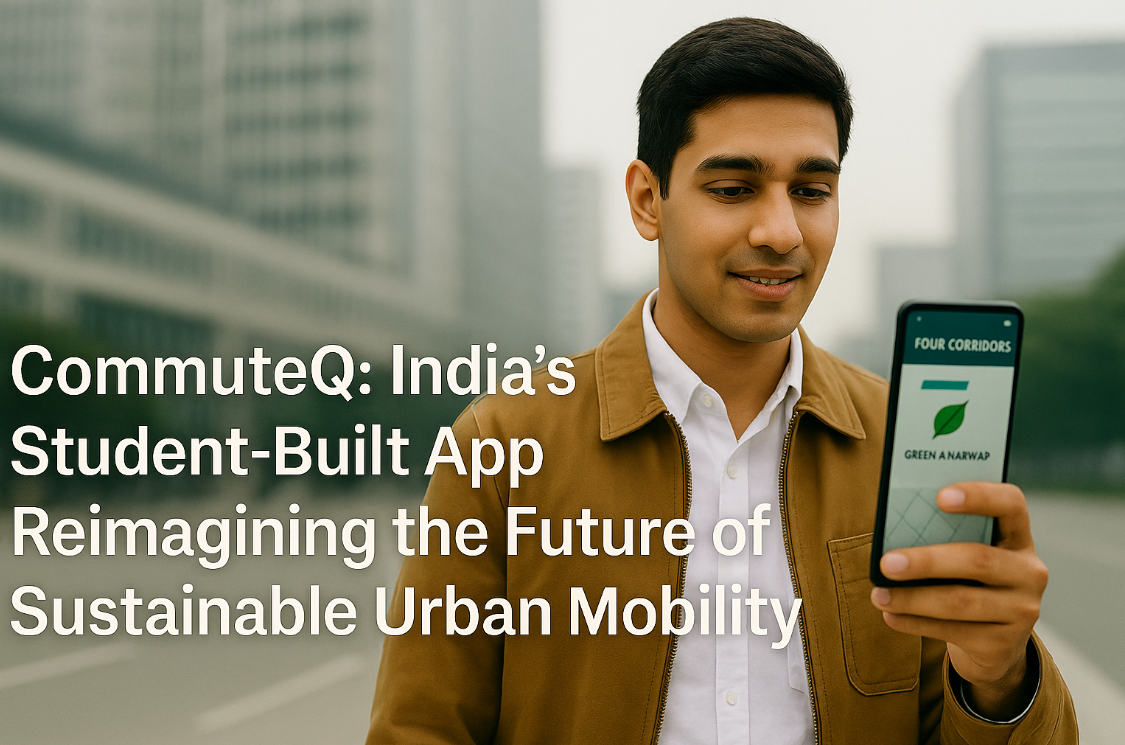
As global cities struggle with traffic congestion, climate-related risks, and overburdened infrastructure, a forward-thinking solution has emerged from India. The Indian Institute of Technology (IIT) Banaras Hindu University (BHU) has developed CommuteQ, a mobile application that recently earned top honors at the Urban Transport Challenge 2025, under the Station Access and Mobility Program (STAMP). This international challenge backed by the Toyota Mobility Foundation, WRI India, and India’s leading metro operators recognizes solutions that are scalable, people-centric, and capable of influencing long-term urban mobility behavior.
CommuteQ is not just a student project it’s a working solution poised to shift how we approach urban commuting across the globe.
Can Smart Technology Redefine Daily Commutes?
Urban transport contributes nearly 24% of global CO₂ emissions, according to the International Energy Agency (IEA), with a large share driven by daily car commutes. While infrastructure expansion remains important, it’s often slow and capital-intensive. CommuteQ takes a different approach by focusing on behavioral design and digital nudges to drive change.
The app offers:
- Gamified mobility quests that reward walking, biking, or taking public transit.
- Personal dashboards where users can view their daily travel footprint and track carbon savings.
- Real-time route optimization, syncing with public transit systems for efficiency and convenience.
These features make sustainability a measurable and engaging habit turning environmental awareness into action.
Bengaluru Pilot: A Test Case for Scalable Impact
Thanks to its STAMP Challenge victory, CommuteQ has secured an ₹83 lakh grant to launch a 9-month pilot in Electronics City, Bengaluru, a major tech and innovation hub. The pilot will track real-world behavioral data, user adoption rates, and reductions in carbon emissions based on commuter choices.
What’s being measured?
- Percentage of users switching from private to public or non-motorized transport.
- Reduction in estimated commute-related CO₂ per user.
- Gamification’s effect on sustained behavior change over time.
Early estimates suggest that if adopted city-wide, CommuteQ could reduce over 15,000 tons of CO₂ emissions annually equivalent to planting more than 600,000 trees.
Powered by Collaboration, Built for Real-World Use
One of CommuteQ’s most impressive attributes is its collaborative development. The project brings together experts from:
- IIT-BHU (technical and design)
- IIT Tirupati (behavioral analysis)
- IIIT Bangalore (data science and app integration)
- IIM Indore (urban policy and adoption modeling)
- ITSPE India (urban mobility research and field testing)
This multi-institutional partnership ensures CommuteQ is not only grounded in advanced technology but also aligned with commuter behavior, local transport realities, and public sector goals.
Could CommuteQ Inspire Global Urban Innovation?
From London to Jakarta, cities are facing strikingly similar urban mobility problems—limited space, worsening air quality, and increasing reliance on private vehicles. What sets CommuteQ apart is its low-cost, scalable, and user-focused approach, making it especially relevant for emerging markets where infrastructure budgets are constrained.
Key global insights:
- Cost-effective: Unlike physical infrastructure, CommuteQ can be deployed widely with limited resources.
- User-empowering: It gives commuters actionable insights, creating a sense of agency.
- Replicable framework: The app’s behavioral science model can be adapted to different cities, cultures, and transit systems.
What the World Can Learn from CommuteQ
- Behavioral nudges can scale faster than infrastructure
Making sustainable choices easy and rewarding encourages long-term change. - Tech doesn’t have to be expensive to be effective
With limited funding, CommuteQ demonstrates that small apps can make a big difference. - Collaboration trumps competition in social innovation
The cross-institutional model serves as a blueprint for research-driven public good. - India’s tech talent is solving global challenges
This is more than a local solution CommuteQ is proof that Indian innovation is global-grade.
🔮 What’s Next for Sustainable Urban Mobility?
As the pilot unfolds in Bengaluru, transportation authorities, urban planners, and civic leaders around the world will be watching closely. If CommuteQ succeeds in driving measurable changes in commuter habits and emissions, it could unlock a new category of climate-tech apps ones that don’t demand massive investment but create massive change.
Imagine a world where choosing public transport earns you real-world rewards, your phone reminds you how many kilograms of CO₂ you’ve saved this month, and city-level carbon tracking is crowdsourced through commuter actions. CommuteQ moves us a step closer to that future.
In a time when climate anxiety is high and innovation fatigue is real, this app is a refreshing reminder that tech solutions for global problems can come from small cities, student labs, and collaborative vision—not just billion-dollar tech giants.